Key risks under the radar
This article first appeared in The Edge Malaysia Weekly on February 23, 2026 - March 1, 2026
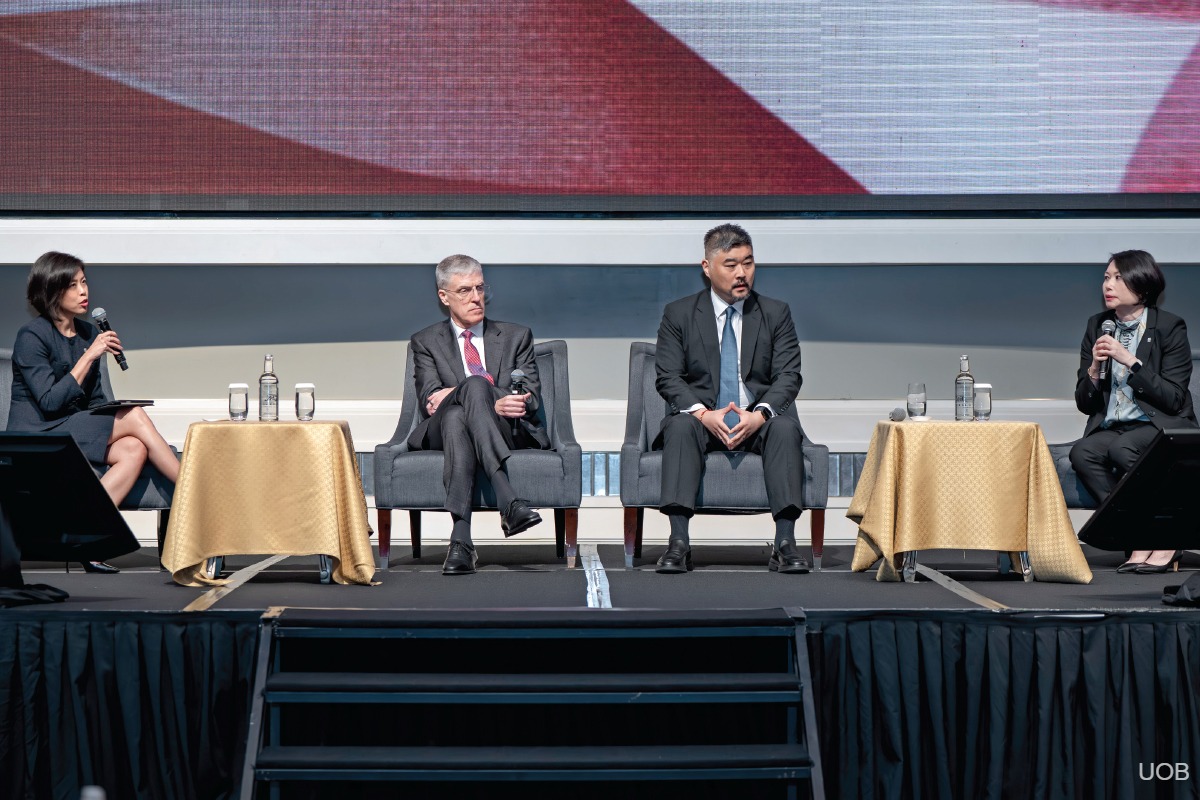
AFTER spotlighting opportunities, the panel session of the UOB Privilege Conversations Investment Outlook 2026 highlighted risks that many investors might have neglected this year.
A risk concerning investors was the circular financing deals between US big tech firms and artificial intelligence (AI) start-ups that led to concerns surrounding operational sustainability, cash flow and return on investment (ROI). Jonathan Curtis, co-chief investment officer of Franklin Equity, is not worried, as he believes market demand is strong enough to support the growth and future earnings of these companies.
“That being said, there are some valid concerns pertaining to financing and ROI within the AI scene. One in particular is specific to OpenAI and its ongoing competition with rivals such as Google (Alphabet Inc).”
Curtis said Google ascended to the consumer AI market with its strong distribution capability and the launch of Gemini 3, at a time when OpenAI announced an enormous spending plan over the next three to five years.
With Google entering the scene as a strong contender, investors should keep an eye on whether OpenAI can raise more capital moving forward, stick to its spending plan, and deliver value amid heightened competitive pressure.
“It is key whether OpenAI can get the capital, keep growing and deliver on its capital spending plan. If it can’t, that’s not just a threat to the tech sector; it’s a threat to the global markets,” he said.
Taking a different lens, Tai Hui, managing director and chief market strategist for Asia at J P Morgan Asset Management, said the market has been focusing on asset prices and valuations, but it should talk more about the underlying issues that could really upset the broad market, both bonds and equities.
A key word for the year is discipline, said Tai, hinting at the ability of governments to stay disciplined in reducing fiscal deficit when debts are piling.
“If you look at the last few years, whether it is the UK or France, even the US, their fiscal positions have become quite stressful. The political environment makes it very difficult for governments to reduce their fiscal deficit. The next country that could face some stress is Japan. They’ve got very high levels of fiscal debt. The new prime minister is calling for an election, and she is using tax cuts as a way of attracting voters.
“A lack of discipline, especially from the government or management perspective, worries me quite a lot. To me, this is really important to focus on or monitor in 2026,” he said.
Julia Goh, senior economist at UOB Malaysia, highlighted three key risks for the year that warrant more attention from the market. First being potential financial risks emanating from the US private credit market, which is now worth US$1.8 trillion (RM7.1 trillion), accounting for about 75% of the global private credit market.
Private credit products are also gaining popularity in Asia among retail investors despite existing regulatory oversight gaps. These are essentially high-risk, high-return products that are less liquid than public market products.
Next is climate risk, which has not garnered enough attention from investors despite its impact, such as severe floods, felt by many Malaysians. Third, there is also the risk of revived geopolitical tensions. As 2025 has shown us only too well, geopolitical scares have a way of moving markets. With that in mind, 2026 could bring more of the same — and investors should be prepared, said Goh.
Later, in response to a question from the floor about the ringgit’s trajectory in 2026, Goh said the bank had initially forecast the ringgit to trade at RM4 against the US dollar (USD) this year. But the target was already hit, and even surpassed, as she was speaking at the event. As at Jan 26, the ringgit was trading at 3.97 against the USD.
Goh said the ringgit could further strengthen in 2026 on the back of several tailwinds, including encouraging economic growth.
Goh said it is still early into the year and there is no way to tell how the ringgit will perform against the USD by year’s end. In any case, she believes the ringgit to be undervalued at present levels. “Fair value-wise, we have always felt that it is undervalued,” said Goh.
At its best estimate, UOB now expects the ringgit to trade as low as 3.85 against the USD by the end of 2026.
The moderator of the panel session was Ong Shi Jie, head of deposits and wealth management at UOB Malaysia.
Save by subscribing to us for your print and/or digital copy.
P/S: The Edge is also available on Apple's App Store and Android's Google Play.
The content is a snapshot from Publisher. Refer to the original content for accurate info. Contact us for any changes.
Comments