Johor: Election War Drums Beating: Johor to test unity of Madani’s coalition of coalitions government
This article first appeared in The Edge Malaysia Weekly on May 25, 2026 - May 31, 2026


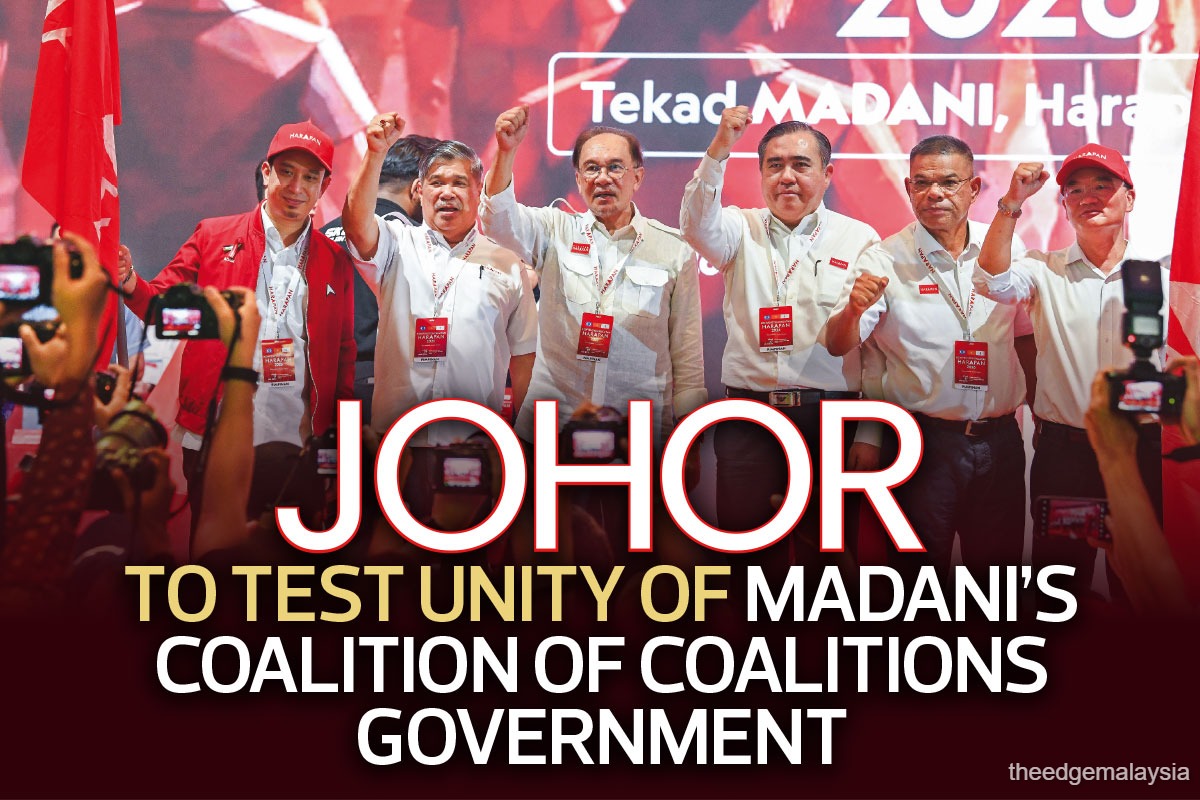
DESPITE being a major city, Johor Bahru’s city centre is quiet in the morning once the office crowd has clocked in and the estimated 400,000 residents have already crossed the Causeway into Singapore. But on the morning of May 17, more than 5,000 people thronged the streets leading to Persada Johor International Convention Centre, many dressed in red and light blue.
The convention centre was packed beyond its 3,500-person capacity. Water supply had also been disrupted for most of the day, making even basic needs difficult to manage.
It was the venue of the Pakatan Harapan (PH) Convention 2026, where leaders of the ruling coalition were expected to present a united front. However, Barisan Nasional’s (BN) decision — announced earlier — to contest all 56 seats in the yet to be called Johor state election was widely seen by delegates as a betrayal.
Prime Minister Datuk Seri Anwar Ibrahim, who is also PH chairman, said in the main hall: “Kalau betul mereka merasakan sudah sampai masanya di negeri-negeri — iya, mula di Johor. Kita sambung di Negeri Sembilan, dan saya renung kalau benar mungkin, saya fikirkan kita lempar; biar rakyat memutuskan keseluruhannya!” (If it is true that they [BN] feel the time has come [to go solo] in the states — yes, starting in Johor. We will follow up with Negeri Sembilan, and I think if it is true, we return the federal mandate to the people and let them decide.)
He then thundered, drawing boisterous cheers: “Kita tak makan ugutan. Pukul, sudah kena pukul. Penjara, sudah. Nak diugut oleh budak-budak, no way.” (We don’t bow to threats. We have been beaten and jailed. If you think we will back down in the face of threats from young kids, no way.)

The 78-year-old’s fiery speech worked in getting his PH supporters riled up as they saw their chairman in his element — charismatic and in fighting spirit — after more than three years of placating all sides in efforts to keep the Madani government intact.
The speech did not elicit any response from Umno president and BN head Datuk Seri Zahid Hamidi. Instead, it was left to BN secretary-general Datuk Seri Zambry Abdul Kadir, who said the coalition accepted BN Johor’s decision.
“Barisan Nasional Malaysia respects the position voiced by Barisan Nasional Johor regarding the direction and preparations for the upcoming state election, in line with the views of all parties within the state Barisan Nasional component parties,” he said in a statement.

“Barisan Nasional holds the position that the understanding and basis for the formation of the unity government after the 15th General Election (GE15) were founded upon national responsibility to prevent Malaysia from being dragged into prolonged political polemics, and this understanding was agreed upon until the mandate ends.”
A political observer who has been following Anwar’s career since the 1990s says: “Anwar is just playing to the gallery; the same goes for Umno. This way, they can get the DAP (Democratic Action Party) bogeyman off their backs as they prepare for the general election.”
For more than two decades, Anwar’s political currency has been that he is the only person who can “reform” the country’s economic and sociopolitical system, and bring about a more prosperous and just future for Malaysians from all backgrounds.
But the results of GE15 in November 2022 pushed PH to form a “unity” government with BN and its offshoots, Gabungan Parti Sarawak (GPS) and Gabungan Rakyat Sabah (GRS).
Meanwhile, Perikatan Nasional (PN) — comprising Parti Pribumi Bersatu Malaysia, Parti Islam Se-Malaysia (PAS) and Parti Gerakan Rakyat Malaysia (Gerakan) — became the federal opposition.
Over the past three years, Anwar has faced criticism from both within and outside his coalition, allegedly for failing to deliver the meaningful reforms promised to the rakyat.
This culminated in a crisis within Parti Keadilan Rakyat (PKR), with former deputy president Datuk Seri Rafizi Ramli resigning from the party and vacating the Pandan parliamentary seat.
While Anwar is seen to be doing what he can to maintain the stability of the Madani government, BN’s decision to contest all 56 seats in the upcoming Johor state election has been viewed as the beginning of the end for the collaboration.
It has also prompted calls from PH supporters for the coalition to contest all 56 seats in the state as well. DAP secretary-general Anthony Loke Siew Fook has likewise called for PH to field candidates in all 36 seats in the Negeri Sembilan state assembly.
“If [BN] Johor wants to contest all 56 seats, then we will contest [all] 36 in Negeri Sembilan. If Johor dissolves [its assembly] tomorrow, Negeri Sembilan will also dissolve tomorrow,” Loke said when addressing the convention.
(It must be noted that the decision to dissolve the Negeri Sembilan assembly rests with the Yang di-Pertuan Besar, on the advice of the menteri besar [MB]. The current Yang di-Pertuan Besar is Tuanku Muhriz Tuanku Munawir and the current MB is PKR’s Datuk Seri Aminuddin Harun.)
But the question is whether both coalitions are ready for three-cornered fights, assuming there is no cooperation with PN. What role could Parti Bersama Malaysia (Bersama) — led by former PKR MPs Rafizi and Nik Nazmi Nik Ahmad — and the Malaysian United Democratic Alliance (Muda) play?
Certainly, the “war drums” have begun, and party machinery is being reactivated. With elections looming, possibly starting with Johor, the political environment is set to become increasingly heated.
BN going solo — a win or loss for PH?
The decision by Johor BN chairman and MB Datuk Onn Hafiz Ghazi for BN to go solo in the Johor state election comes as no surprise, as there had been months of speculation over whether the party would continue working with PH into the next election cycle.
The move underscores BN’s confidence in its own strength in Johor, which it displayed in the previous state poll, when it garnered more than two-thirds of the state assembly, or 40 seats, compared with 12 seats won by PH. Still, it is seen as a slap in the face for PH.

Dr Sivamurugan Pandian, professor of political sociology at Universiti Sains Malaysia, says: “For BN, going solo is a calculated show of strength and confidence. For PH, it is high-risk because vote-splitting in urban seats could weaken them badly.
“For PN, the more fragmented the anti-BN vote becomes, the more opportunities they gain in Malay-majority seats.”
BN is expected to do well in the upcoming Johor state election, even possibly securing two-thirds majority again, like it did in 2022. This is due to the popularity of Onn Hafiz as well as the crises within Bersatu and PKR.
BN grassroots leaders whom The Edge spoke to are confident of a strong showing by the coalition in the state. Some Johor-based Malaysian Chinese Association (MCA) leaders are confident of retaining the party’s four state seats and are eyeing two more in the northern part of the state.
In the March 2022 state election, MCA wrested the Bekok, Yong Peng, Paloh and Pekan Nanas seats from DAP. It lost in Tangkak, Jementah and Johor Jaya by margins of less than 5%.
An MCA grassroots leader tells The Edge that Tangkak and Jementah could become a real battleground in the state election. A slight swing in voter support could be enough to tip both seats to MCA, which emerged as runner-up in the previous election.
DAP won the Tangkak seat by a thin 1.8% margin in a five-corner fight, and Jementah by 3.2%.
It has to be considered, however, that the 2022 state election had a low turnout of 53.6%.
“Sentiment in the city and rural areas is different. Voters [in rural areas] are more focused on bread-and-butter issues rather than idealism,” says the MCA grassroots leader.
Tangkak, known for its rows of textile and garment shops, is a semi-urban constituency under the Ledang parliamentary seat. Meanwhile, Jementah, a small town with an economy largely rooted in agriculture, falls under the Segamat parliamentary seat. Both seats have been represented by PKR since November 2022.
It must be noted that BN benefits in a three-cornered fight in Johor. In the 2022 state election, 22 of the 40 seats that BN secured were the result of three-cornered fights, where the coalition won even when it failed to secure a majority of the votes.
In the Bukit Pasir state seat, for example, BN secured only 31.4% of the total ballot, slightly above the 30.3% secured by PN, while PH managed to secure 24.3% of the total votes.
The seat is part of the Pagoh constituency, which is represented by Bersatu president Tan Sri Muhyiddin Yassin.
Meanwhile, seven of the 12 seats won by PH in the 2022 Johor state election were in constituencies where it did not secure more than 50% of the total votes. These include Bukit Batu in the Kulai parliamentary seat, Simpang Jeram in Bakri, and Tangkak. Both Kulai and Bakri were won by DAP in GE15.

Of the 22 seats where BN won with less than 50% of the total votes, only eight could have gone to PH, as it was the party with the second highest vote share in those constituencies: Pemanis, Kemelah, Parit Yaani, Senggarang, Mahkota, Kempas, Kota Iskandar and Pulai Sebatang.
It could have also won in Tenang and Bukit Permai as well as Larkin had PH not got into a political pact with Muda, which stood in both Tenang and Bukit Permai, while both Muda and PH stood in Larkin, a constituency in Johor Bahru.
Meanwhile, PN could have won in Bukit Pasir, Gambir, Serom, Bukit Naning, Sungai Balang, Semerah, Parit Raja, Rengit, Tenggaroh, Tiram and Permas, as it was the coalition with the second most popular votes.
Johor a testing ground; DAP to work with PAS?
While BN has decided to go solo in the upcoming Johor state election, it remains unclear whether it will also part ways with PH in other upcoming state elections, as well as GE16.
Johor could serve as a testing ground, however, for both BN and PH to assess whether going it alone would serve them better at the ballot box or otherwise. The other upcoming state election is in Melaka, and possibly Negeri Sembilan, amid ongoing political and constitutional uncertainties in the state.
The state of BN–PH relations will shape Anwar’s decision on whether to call a snap federal election. During the convention, he said PH would not hesitate to contest all seats in Negeri Sembilan, Penang, Pahang and Selangor.
The political observer whom The Edge spoke to says Parliament is unlikely to be dissolved alongside the Johor and other state assemblies.
“One strategy would be to let the states that are due for elections go first,” he says. “At the federal level, managing the crisis arising from the war in Iran takes precedence.
“I don’t see a snap GE this year. If the Madani government manages the crisis well, that becomes the selling point — that this unity government can manage the economy better than its opponents can.”
However, the ballooning monthly petrol subsidy bill, now at RM7 billion, coupled with cascading supply chain disruptions from petrochemical shortages — such as plant shutdowns and job cuts — could also work against the Madani government as the war drags on.
While the likelihood of a snap GE appears minimal, BN Johor’s decision underscores today’s political reality — that no single coalition is likely to secure a parliamentary majority on its own.

“In many ways, Johor could become the testing ground for whether Malaysia is moving back towards a dominant-party model under BN or towards a fragmented multi-coalition era where no bloc can easily dominate anymore,” says USM’s Sivamurugan.
This is not the first time Madani government partners have contested against each other in an election. In the Sabah state election last November, PH, BN and GRS stood separately, although PH and GRS entered a pact not to challenge one another.
With GRS managing to form a government with PH and BN after a hung assembly, the Sabah election shows that pre-election pacts are not necessary for a coalition government to be formed post-election.
GPS will also have to consider whether to contest against PH in the upcoming Sarawak state and general elections, particularly in seats where PH is the incumbent.
DAP MPs are the incumbents for Bandar Kuching, Sibu, Lanang, Mas Gading and Stampin in the federal Parliament, as well as Padungan and Pending in the state assembly. Meanwhile, Anwar’s PKR holds Miri at the federal level in Sarawak.
These political realities have also opened up the possibility of different coalition configurations at the federal level, should GE16 again result in a hung Parliament.
It is no secret that PH is in talks with PN —particularly PAS — to potentially join the Madani government, should Umno-led BN decide to go it alone in the event that no party or coalition secures 112 seats, the majority required to form a government, in GE16.
DAP is also weighing whether to remain in the Madani government, with a decision expected next month, if it is dissatisfied with the government’s reform efforts, following its poor showing in the 2025 Sabah elections.
A DAP MP who spoke to The Edge says the appointment of Terengganu Menteri Besar Datuk Seri Ahmad Samsuri Mokhtar as PN chairman and federal Opposition leader has helped ease discussions between PH and PN.
“We just need to solve a few standing issues between DAP and PAS, such as the admission route to public universities for students with UEC qualifications,” says the MP prior to the PH convention.
Asked how DAP supporters might react if the party and PH were to enter into a pact with PAS — given the fundamental ideological differences between the two — the MP points to supporters’ earlier enthusiasm for cooperation with Umno.

“During the negotiation phase, our supporters were urging us every day to work with Umno to form the unity government,” the MP said, suggesting that for many DAP supporters, Umno is viewed as the “lesser evil” compared with PAS.
There are also suggestions that DAP could sit out altogether any government involving PAS. If that were to happen, however, and Chinese voters continue to back the party, it could result in the community having a diluted voice in the federal government.
What about the people?
As political leaders jockey for position in their pursuit of power, public aspirations appear to be increasingly sidelined. Parties that have lost the popular mandate can still find themselves in government because of the need to form a coalition government (see “Fragmented politics raises stakes in Johor” on Page S6).
In recent years, Johor has experienced an economic resurgence, driven by increased investment, particularly in data centres. Approved investments in the state more than doubled to RM110 billion in 2025 — accounting for 25% of the national total — from RM48.5 billion in 2024.
Yet, Johoreans continue to complain about the high cost of living as they compete for resources and services with Singaporeans, who typically earn at least three times the average local income.
Small business owners continue to grumble about the cost of doing business in Johor, while workers in the state — those not employed in Singapore — are grappling with high property prices and, by extension, a higher cost of living.
A hairstylist at a salon near JBCC shopping mall says renting a room in the city can cost more than RM1,000 a month. Johor’s median wage stood at RM2,982 as at December 2025, according to the Department of Statistics Malaysia.
“It is very hard to make ends meet with the wages we have here in JB,” the hairstylist tells The Edge. “That is why so many of us leave to work in Singapore; we can earn three times more.”
But that comes at a price, with workers facing long daily commutes to and from the city state.

Although the Johor-Singapore Rapid Transit System is nearing completion, the hairstylist does not expect it to ease congestion at the Bangunan Sultan Iskandar Customs, Immigration and Quarantine (CIQ) complex.
“The fares are not going to be cheap. If people had to pay RM50 every day to commute between Johor and Singapore, they would rather take the bus, ride a motorcycle or just walk across the Causeway,” she says.

Meanwhile, the owner of a café serving gelato in the historic core of downtown Johor Bahru, which opened just three months ago, says sales have fallen short of expectations, especially on weekdays, when fewer Singaporeans visit, compared with weekends.
Shoplot rents have also risen sharply since before the Covid-19 pandemic. The hairstylist whom The Edge spoke to says rent for the salon’s branch at Johor Bahru City Square has nearly doubled over the period.
“Before the pandemic, we were paying around RM20,000 a month. Now, it is about RM40,000. Rent at Mid Valley Southkey is even higher, and they are very selective when it comes to tenants,” she says.
Even so, Johor MB Onn Hafiz’s hands-on approach to addressing issues has earned public appreciation (see “Onn Hafiz emerges as BN’s strongest asset in Johor” on Page S7). That may be one reason BN has decided to go solo in the next state election, widely expected to be called by July. The outcome will be a major test of the unity of the Madani government at the federal level.
Read also:
Johor state assembly dissolved for fresh election
Statistics and facts you need to know about Johor state polls
Johor state seat composition over the years
Onn Hafiz emerges as BN’s strongest political asset in Johor
Johor economic boom fuels concerns over wages, housing and inequality
Fragmented politics raises stakes in Johor
Save by subscribing to us for your print and/or digital copy.
P/S: The Edge is also available on Apple's App Store and Android's Google Play.
The content is a snapshot from Publisher. Refer to the original content for accurate info. Contact us for any changes.
Comments