Breaking Apollo away from the school-bag staple mould
This article first appeared in The Edge Malaysia Weekly on February 9, 2026 - February 15, 2026
ON paper, Apollo Food Holdings Bhd’s (KL:APOLLO) latest financials may give cause for concern. Net profit for the first half of FY2026 had tumbled by nearly a third, revenue is down and inventories are at a five-year high while receivables hit a record.
Yet, the company declared a generous interim dividend of 15 sen per share — 87% of first-half earnings, above its 50% to 60% guidance. The move is meant to signal to the market that the “worst is over” for Apollo, says its managing director Cheah Jia Ming.
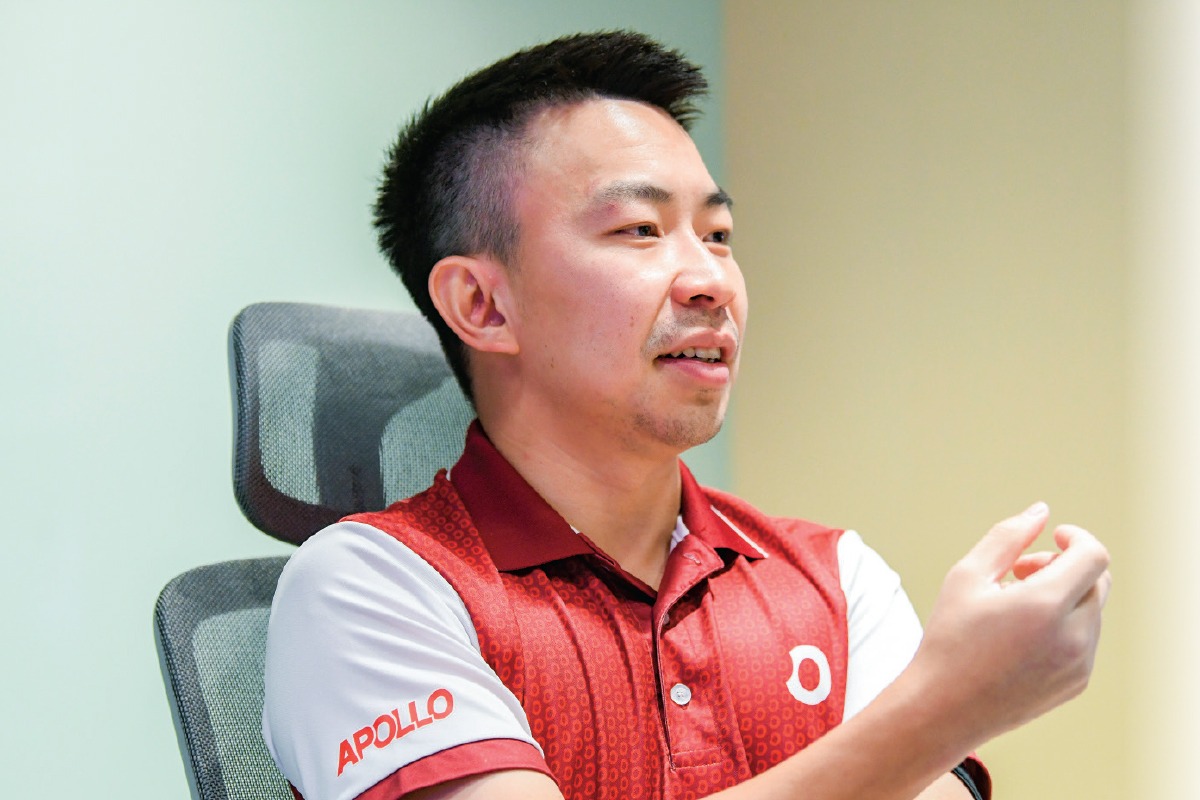
Jia Ming and his father Datuk Cheah See Yeong, Apollo’s executive chairman, are attempting to morph the 1990s schoolbag icon into a consumer staple in the digital era with a complete makeover of the company’s operations, which includes an overhaul of its route-to-market processes on top of a significant upgrade of its manufacturing facilities. Cheah senior is also the founder of Scoop Capital Sdn Bhd, which owns the master franchisee for Baskin-Robbins in Malaysia and Singapore (Golden Scoop Sdn Bhd) and acquired Apollo just over two years ago when the founding Liang family signalled their intent to exit.
“We didn’t go around looking for an acquisition [nor was it an aggressive takeover] — it was through our [shared] auditor. When we took a look at [Apollo’s business], we saw so much potential,” Jia Ming reveals.
Scoop Capital won the deal on numbers plus chemistry. “We visited them and we just clicked. They’re Teochew and we’re Teochew. For them, it was important to see the company go into hands where it can grow and not just be flipped. We are not in the game of flipping things. I think they’re comforted by that.”
So, in December 2023, Scoop Capital acquired the founding family’s entire 51.31% stake for RM238.08 million. The purchase triggered an unconditional mandatory takeover offer for the remaining shares at RM5.80 each, a 7.4% premium to the company’s share price then. For about RM365 million, Scoop Capital had 78.4% of Apollo when the offer closed in late January 2024 but has since reduced its stake to 74.8% to comply with Bursa Malaysia’s 25% public shareholding spread requirement.

Breaking the ’90s time capsule
Apollo, whose iconic layer cakes and chocolate wafers were a staple of school canteens and kedai runcits for decades, was cash-rich, debt-free and efficient in its own way. Yet, for a multimillion-ringgit market leader, the Cheahs found the simplicity of its internal operations striking: the sales engine was essentially a two-person team that simply waited by the phone for orders, stock planning was anchored more by historical intuition than hard data and its warehouse operated entirely without WiFi and relied on the humble paper and pen to track millions of ringgit in inventory. The distribution chain was equally old-school. Jia Ming recalls a wholesaler who still stashed his daily takings into a Milo tin that had been turned into a makeshift cash can.
“The company was still in the 1990s — its people, system and infrastructure,” Jia Ming opines.
This was not due to a lack of capability but rather the founding Liang family’s famously conservative approach to investment — an ethos of “why fix something that’s not broken”. Indeed, for a long time, nothing was broken. While its fiscal discipline kept Apollo resilient, it also set a ceiling on its potential, one that its new leadership hopes to unlock.
One of the first things the Cheahs did after the takeover was kickstart a RM120 million upgrade to its cake manufacturing plant in Johor that was running at 100% capacity.
“To install the new cake lines, we have to upgrade the plant’s water treatment plant to manage wastewater,” says Jia Ming of the upgrade, which is still ongoing.
Jia Ming, who handles the strategy, says his father spends his weeks in Johor overseeing civil construction and haggling with contractors — leveraging his background in building materials — to ensure the factory’s “bones” are up to standard without interrupting production.
While only two new cake lines are being installed to boost capacity by 40% by end-2026, Jia Ming says the production floor can be scaled up to add another two new cake lines when the additional capacity is needed.
The Cheahs also started an entirely new commercial team with people experienced with fast-moving consumer goods (FMCG) from multinational corporations like Nestlé and Munchy’s to drive sales and marketing.
After spending the first year “planning and learning everything” about the business, the team spent the second year overhauling the traditional distribution network — slashing its legacy base of 43 local wholesalers down to two, which visibly impacted its bottom line.
The move may be risky but was “very necessary”, says Jia Ming, who deems the old ways unsustainable. “To grow, we needed to bring the company into the present.” To fill the gap, Apollo engaged nine new strategic partners, which agreed to invest in expanding the customer base in exchange for “support” from Apollo like longer credit terms.
Unlike its previous “black-box middleman” model, where wholesalers guarded their sales data, its new stable of 11 wholesalers — who each cover specific territories — are required to provide sell-out data. This allows Apollo to transition from what Jia Ming calls reactive management to a more data-supported inventory planning where demand is anticipated. Knowing whom its products are sold to, where they are sold at and at what price also gives the company better pricing control.
“We’ve just started doing [advertising] for about six months and it’s very digital. TikTok, Instagram, social media,” says Jia Ming.

The company also opened retail kiosks — one in The Mall, Mid Valley Southkey, Johor Bahru, and another in Mid Valley Megamall, Kuala Lumpur — which also serve as the brand’s first physical link with the younger demographic to help reposition Apollo as a fun treat for any time of the day, not just a schoolbag staple.
It also restarted research and development. “Nowadays, matcha and yoghurt-based flavours are trendy … In the future, we will have healthier products — less sugar, better ingredients. Once we have built a strong foundation and capability, we can develop all that.”
Apollo 2.0: Elevating the legacy bite
The company is taking care not to “kill the old” favourites as it introduces Apollo 2.0, a portfolio of refreshed products designed for a generation that “consumes less but wants better stuff”.
“These are the legacy products that’ve been transformed. We add ingredients and make them more ‘kaw’. Let’s say our traditional chocolate-coated wafer in the classic pink wrapper that has more wafer than chocolate. In Apollo 2.0, we have this new product in red packaging that is more chocolate than wafer,” Jia Ming explains.
The new product range leverages the company’s strength in chocolate coating, Jia Ming says, pointing to the long-time success of its layer cakes, for which Apollo is “the market leader”. On the other hand, the wafer market can be crowded, he notes.
“What differentiates us is we can do fully coated [wafers]. The closest similar product is Kit Kat,” he says. But while Kit Kat or premium European brands occupy the high end, Apollo plans to dominate the space between school canteen snacks and luxury treats.
“Our coating now is a low-cost coating. We aspire to go nearer to that [international] mouthfeel and product quality but at a way lower price,” Jia Ming explains.
Unlike many biscuit players who have to outsource the coating and find it expensive, Apollo can produce its chocolate compound in-house. “We buy the ingredients and make the coating ourselves. We have the infrastructure and capacity to do it, and this has a lot of room to grow.”
When asked if this is a “premiumisation” play, Jia Ming offers a more grounded analogy. “I think it’s more about being relevant. It’s like Proton,” he says, referring to the national car maker’s transformation under Geely. “From the old Saga, they are now offering better products. The price may have gone up a bit but it’s still Proton. You can’t turn into a BMW overnight but you can go nearer to it. We want to revitalise the experience first — getting consumers’ mindshare and comfort-share — before any ‘premiumisation’ takes place.”
This strategy is also fundamentally a margin play. For years, Apollo’s gross profit (GP) margin has hovered around 27% to 28%, which is respectable for a legacy setup but below the industry benchmark, says Jia Ming. His team aims to push its GP margin past the 30% mark.
This is not just about sticking a higher price tag. While Apollo did raise prices twice recently — once in September 2024 and again in January 2026 to combat rising raw material costs — the company has made clear that pricing is a “last resort” and that the “focus is on efficiency gains”.
This means keeping a close eye on its new distribution logistics. “There’re so many parties involved, so execution needs to be done well. We can have our products everywhere in the world but if we don’t move before certain dates, then it’s all wastage. We are conscious about that,” says Jia Ming.
One might wonder if the introduction of the new product range and flavours might lead to a crossover with his other business Baskin-Robbins. Jia Ming acknowledges the potential but is in no rush to force a gimmick.
“We would not discount any potential collaborations in the future, like flavour inspiration, but currently the focus is not there,” he says. For him, the priority remains on the structural health of the company rather than marketing noise.
There are now eight “refreshed” products under Apollo 2.0 and the company plans to introduce more this year. “We have a stable of great products that were just never marketed. These are products that didn’t really take off because they never had the shelf space — they were not visible to the consumers. To the market, they will appear new.”
Priced for growth
Reflecting a shift in expectations from a reliable cash cow to a growth company as the new management aims to “double up” sales and earnings in five years, Apollo’s share price went from around RM4-levels prior to the takeover to past RM7 in March 2024. While the stock had given up some of those gains, it had remained above RM6 even after the recent earnings dip. It closed at RM6.04 on Feb 5.
As of early 2026, Apollo’s price-earnings ratio sits near 15 times, compared to about nine to 11 times in the past (excluding the pandemic blips). This places it at a premium compared with its closest peer Oriental Food Industries Holdings Bhd (KL:OFI) of around 8.4 times and close to the 16 times multiple of Hup Seng Industries Bhd (KL:HUPSENG), whose Ping Pong cream crackers are also a part of many Malaysian childhood memories.
Apollo recently sought to renew its 10% share buy-back mandate, an authority it first obtained in October 2024 but has yet to use. It was also the group’s first ever buy-back mandate.
Meanwhile, to protect its balance RM77 million cash pile as “rainy day” buffer, Jia Ming plans to break Apollo’s decades-long debt-free streak. The group will tap bank borrowings for the final phase of its RM120 million capex in the second half of 2026, while maintaining its 50% to 60% dividend guidance. “Our working capital is quite high because we pay our suppliers in cash and our business is growing, so it’s better to have more cash in hand,” adds Jia Ming.
FY2026 for reset, FY2027 for growth
Management has flagged that the current financial year ending April 30, 2026 (FY2026), will be a “reset year” when the company “bites the bullet” and absorbs the impact of its structural overhaul, says Jia Ming.
Indeed, the first half witnessed two consecutive declines in quarterly earnings, which pulled Apollo’s net profit for the first six months ended Oct 31, 2025 (1HFY2026), down 31% to RM13.80 million from RM20.29 million a year earlier. Revenue dropped 6% to RM140.33 million from RM149.35 million.
Inventories rose to RM31.28 million while receivables climbed to a record high of RM43.10 million, as Apollo adjusted from a near “cash-and-carry” model towards a modern supply chain where it supports larger retail partners with longer credit terms to secure better shelf space.
“Our first half (ended Oct 31, 2025) was terrible but we have guided that the second half will be better. The third and fourth quarters should start giving a bit of confidence that what we are saying is coming true. In FY2027, once our new cake lines are in and capacity increases, there’ll be another growth,” says Jia Ming.
The company will also be looking at further improvements in its wafer plant in FY2027 and FY2028, where utilisation now stands at about 50% to 60%. Jia Ming believes this can reach 70% to 75% with better factory realignment “to clear the bottlenecks”.
Apollo will also be looking more aggressively at export markets. Indonesia already contributes 70% of exports, thanks to a strategic positioning of its “Roca” product as a festive staple.
The company has “a few markets in the [target] pipeline” including the rest of Asean, says Jia Ming, adding that Apollo has received enquiries from the Middle East. “Nothing is concrete yet but we are definitely exploring because we know our new capacity will be coming to life sometime in the second half of this year.”
With Ng Yau Chuan — the former chief marketing and digital officer of Loob Holding Sdn Bhd, Tealive’s operator — installed as Golden Scoop’s CEO, Jia Ming says 80% of his time now is spent at Apollo, maintaining only a weekly catch-up with the team at Baskin-Robbins.
The market will be watching closely to see if the Cheahs’ high-stakes makeover for Apollo can successfully transform the nostalgic school canteen icon into the modern FMCG powerhouse it aspires to be.
Save by subscribing to us for your print and/or digital copy.
P/S: The Edge is also available on Apple's App Store and Android's Google Play.
The content is a snapshot from Publisher. Refer to the original content for accurate info. Contact us for any changes.
Related Stocks
Comments